
National Monument | Washington D.C
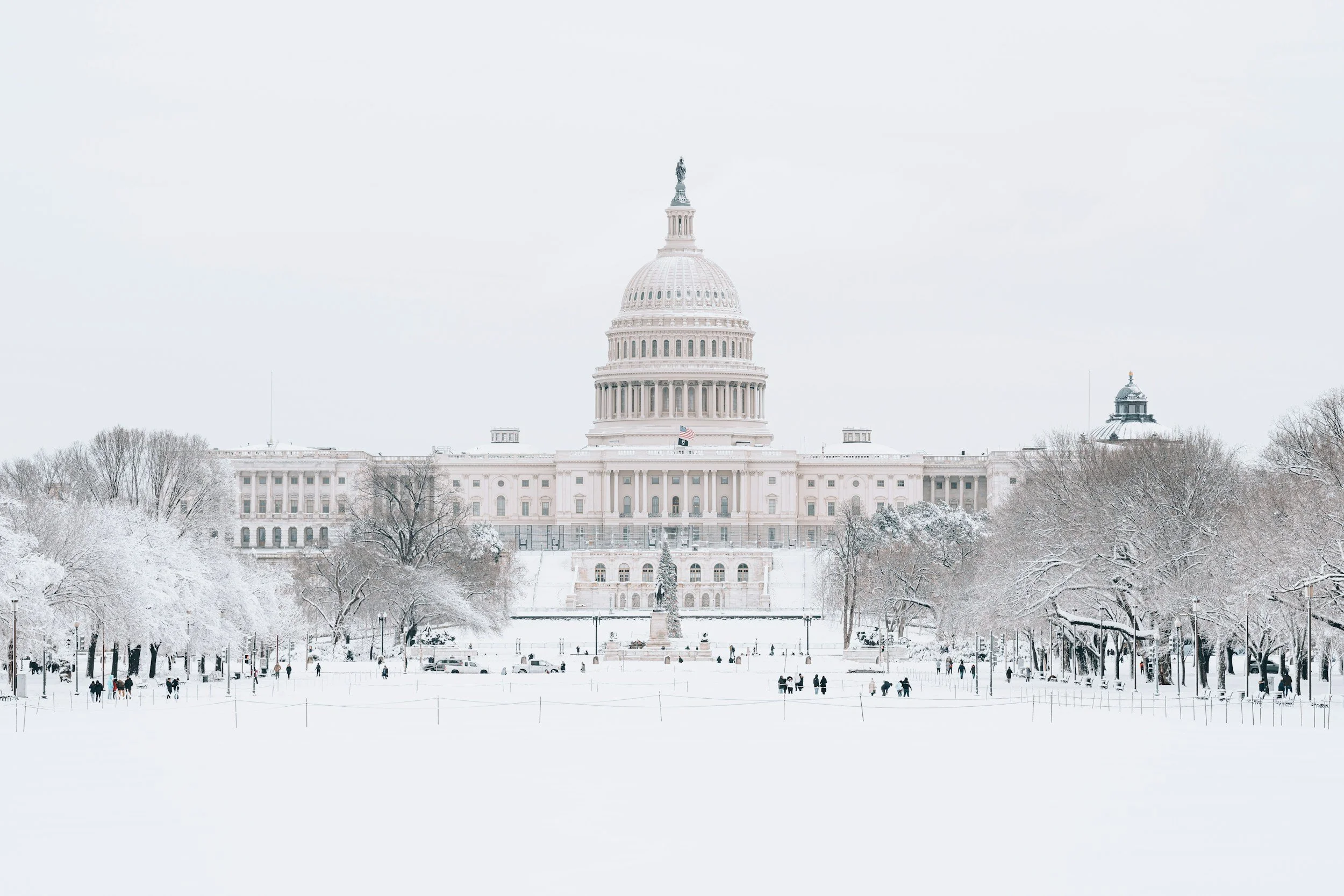
It is freezing in Washington, D.C., in January, and I really do not want to run this morning. I stand in the hotel room for a while looking out the window, deciding. Down on the street, a man in a reflective vest salts the sidewalk in slow arcs. I could run later. I could use the treadmill downstairs. I could skip one day. Eventually, I pull on tights, another layer, gloves, and a hat, and head outside. The cold hits my face immediately. It stings. I do a few jumping jacks on the sidewalk, trying to warm up, but my fingers are already cold inside my gloves when I start running. My breath forms a small cloud in front of me, mixing with the exhaust from cars moving through the morning streets.
Washington is almost too beautiful this early. The buildings sit back from the road behind enormous steps, columns, domes, and stone facades. There is marble everywhere, and granite. Brass lamps glow behind tall windows . The National Mall seems surrounded by beautiful buildings that house something important. The National Archives houses the Constitution, sealed under glass. The Museum of Natural History houses the Hope Diamond. The American History Museum houses the flag that flew over Fort McHenry in a dim room where temperature, humidity, air quality, and even the amount of light is carefully controlled to slow its deterioration.
That is when I see him.
At first, he looks like a pile of blankets on top of a steam vent. A supermarket cart is parked close by, its wheels turned in different directions, a black trash bag knotted to the handle. He is sleeping directly over the vent. Steam rises beneath him in a steady column, moving through the blankets, through the gaps between the layers before disappearing into the January cold. The iron grate beneath him is the only patch of ground on the block without frost.
He has folded himself into the smallest shape he can make, knees drawn toward his chest, shoulders rounded. I cannot see his hands or his feet. A dark knit cap sticks out from beneath one blanket. Another blanket lies over that, then something that looks like a coat, although I cannot tell whether he is wearing it or using it as another layer. One edge of the blanket is dark with the dampness of the steam. Where it hangs past the grate, the damp fabric has frozen stiff. Everything has been pulled tight around him. In front of him, rising cleanly into the winter sky, is the Washington Monument. Five hundred and fifty-five feet of marble, granite, and stone narrowing upward into a perfect point. Across the street, the National Gallery waits behind its columns and bronze doors. Inside are canvases hundreds of years old, wood panels that cannot be allowed to swell, pigments that fade under too much light, varnishes that cloud when the air changes. Sensors watch the rooms day and night. The temperature barely moves. Neither does the humidity.
The wind catches the edge of the man's blanket, but he does not wake.
“Advertisement for the Waldorf-Astoria.”
Fine living . . . a la carte?
Come to the Waldorf-Astoria!
LISTEN HUNGRY ONES!
Look! See what Vanity Fair says about the
new Waldorf-Astoria:
"All the luxuries of private home. . . ."
Now, won't that be charming when the last flop-house
has turned you down this winter?
Furthermore:
"It is far beyond anything hitherto attempted in the hotel
world. . . ." It cost twenty-eight million dollars. The fa-
mous Oscar Tschirky is in charge of banqueting.
Alexandre Gastaud is chef. It will be a distinguished
background for society.
So when you've no place else to go, homeless and hungry
ones, choose the Waldorf as a background for your rags—
(Or do you still consider the subway after midnight good
enough?)
Langston Hughes, 1931
